


Custom Fabricated Parts for Manufacturers: Brackets, Frames & One-Offs for NJ, NY, and CT

Updated: Sep 29
In modern manufacturing facilities across New Jersey and New York, unexpected equipment downtime or stalled production lines can cost thousands of dollars per hour. Whether you manage an OEM assembly line in Bergen County, run a chemical processing plant in Downstate New York, or supervise a commercial equipment build in Upper New Jersey, reliable custom metal component supply is critical to keeping operations profitable.
Catalog hardware doesn't always accommodate specialized equipment retrofits, and high-volume metal stampers rarely accept low-volume prototypes or one-off emergency replacement parts. That is where agile contract fabrication bridges the gap.
At Structural Welders, we manufacture precision custom parts—ranging from heavy structural machinery beds and industrial mounting brackets to specialized assembly fixtures and low-volume production runs. Combining AWS-certified shop capabilities with clear technical communication, we ensure your components arrive on time and fit correctly on the first drop.

1. Why Regional Manufacturers Outsource Custom Fabrication
Maintaining full internal metal fabrication infrastructure—plasma cutting tables, heavy press brakes, certified welding bays, and finishing stations—demands significant capital investment. For many plant operators, keeping dedicated metalworking teams in-house is either inefficient or outside their core competency.
Partnering with a specialized contract metal fabricator provides distinct operational advantages:
Scalability Without Overhead: Outsource short-run subassemblies, safety guards, and machine bases without expanding facility square footage or acquiring expensive CNC machinery.
Certified Welding & Technical Precision: Complex assemblies require experienced welders skilled in distortion control, full joint penetration (CJP) welds, and material metallurgy across carbon steel, stainless steel, and aluminum.
Rapid Prototyping & Emergency Response: When a key machine frame fails or an assembly line requires immediate modification, local regional fabricators deliver short lead times that overseas suppliers cannot match.
2. Industrial Components We Fabricate
We manufacture tailored components engineered for industrial performance, plant maintenance, and OEM product integration.
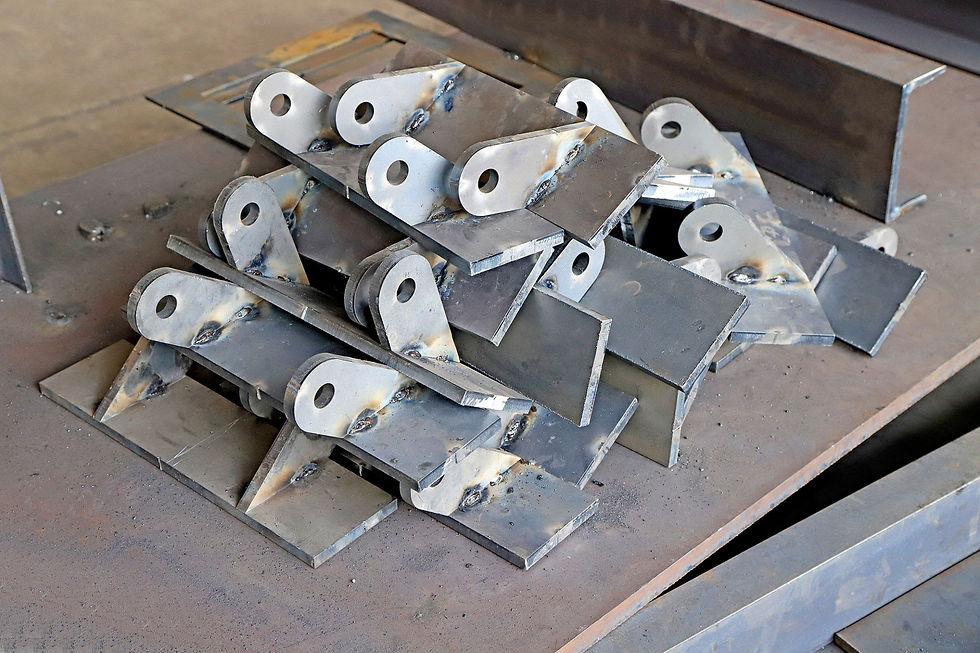
Custom Brackets & Mounting Hardware
Custom brackets serve as the structural interface between standardized machinery and custom plant architecture:
Heavy-Duty Motor Mounts: Precision-cut gusseted plates engineered to absorb continuous motor torque and dynamic vibration.
Structural Adapter Plates: Pattern-drilled mounting plates used to align new equipment onto legacy machine beds.
Corrosion-Resistant Hardware: Stainless steel or hot-dip galvanized brackets designed for sanitary washdown zones in food, beverage, and pharmaceutical plants.
Industrial Frames, Machine Skids & Enclosures
Structural rigidity is vital when constructing subframes that support heavy automation gear, hydraulic units, or material conveyors:
Tubular Steel (HSS) Frames: Square and rectangular structural tubing weldments offering high strength-to-weight ratios.
Structural C-Channel & Beam Skids: Heavy-gauge steel bases designed for modular skid systems or transportable industrial equipment.
OSHA Machine Guards & Safety Covers: Custom sheet metal and expanded metal enclosures engineered to meet workplace safety guidelines.
Production Fixtures & One-Off Assemblies
Custom one-off parts solve immediate production challenges or assist internal manufacturing workflows:
Welding & Assembly Jigs: Precision clamping fixtures that lock multi-part assemblies into exact alignment during internal production.
Heavy-Duty Material Handling Carts: Custom industrial dollies, steel transport racks, and staging frames built for demanding shop floors.
Legacy Machine Components: Reverse-engineered metal parts for equipment no longer supported by original manufacturers.
3. The Contractor & OEM RFQ Checklist
A complete Request for Quote (RFQ) prevents delayed estimates and ensures immediate production scheduling. When submitting specs to your fabricator, include these key items:
Dimensional Drawings or CAD Models: Provide 3D vector files (.STEP, .IGES) or 2D CAD files (.DXF, .DWG) for automated laser/plasma cutting. Fully dimensioned PDFs or clear sketches are also acceptable.
Material Alloy & Thickness: Specify exact grades (e.g., ASTM A36 carbon steel, 304/316 stainless steel, or 6061-T6 aluminum) and material gauge or plate thickness.
Production Quantities: State whether the order is a single prototype, a one-off emergency replacement, or a recurring batch run.
Surface Finishing Standards: Detail required coatings, such as raw/uncoated, rust-inhibitive shop primer, industrial powder coating, or hot-dip galvanizing (HDG).
Critical Fit-Up Notes: Highlight key tolerances, mating bolt patterns, machined bearing seats, or pin locations so shop technicians can plan machining sequences accordingly.
4. Engineering Strategies to Accelerate Lead Times
When faced with tight installation windows or plant shutdown schedules, applying these design practices helps accelerate fabrication turnaround:
Distinguish Critical-to-Function (CTF) Dimensions
Avoid over-specifying tight tolerances (+/- 0.005") across non-critical exterior plate edges. Focus precision callouts exclusively on mating hole centers, bearing seats, and mounting faces, while allowing standard shop tolerances (+/- 1/16") on secondary geometry.
Provide Sample Parts for Reverse Engineering
If original drawings or CAD models are missing—common with legacy equipment—supplying a physical sample allows fabricators to quickly measure, model, and reproduce the part using precision layout tools.
Allow Material Grade Substitutions
Supply chain fluctuations can occasionally impact local stock of specific tubing wall thicknesses or plate sizes. Indicating on your drawings that equivalent structural alloys are acceptable (e.g., "A500 Grade B tube may be substituted with A500 Grade C") allows immediate material sourcing from regional inventories.
5. Material Selection Guide for Custom Parts
Selecting the appropriate metal alloy balances mechanical strength, weight, corrosion resistance, and overall manufacturing cost.
Alloy | Strength | Corrosion Resistance | Weldability | Typical Applications |
A36 Carbon Steel | Moderate | Low (Requires Primer/Paint) | Excellent | Machine skids, mounting plates, structural frames |
304 Stainless Steel | High | High (Sanitary/Washdown) | Excellent | Food & pharma processing brackets, washdown covers |
316 Stainless Steel | High | Exceptional (Chemicals/Salt) | Excellent | Harsh chemical tanks, marine environment frames |
6061-T6 Aluminum | High (Strength-to-Weight) | Moderate to High | Good (TIG/MIG) | Lightweight machinery guards, robotic fixtures |
6. Frequently Asked Questions (FAQs)
What information is needed to get a fast quote for custom metal parts?
To get an accurate quote quickly, provide a 2D/3D CAD file or dimensioned drawing, the material grade and thickness, required quantity, surface finish requirements (such as raw, primed, or powder-coated), and any critical tolerance callouts.
Can you reverse-engineer a custom part if I don't have CAD drawings?
Yes. If you don't have digital CAD files or original prints, you can provide a physical sample part. Our technical team can measure, model, and reverse-engineer the component to create precise fabrication drawings for production.
What welding certifications apply to custom structural machine frames?
Structural steel frames and load-bearing machine bases are typically fabricated in accordance with AWS D1.1 (Structural Welding Code - Steel) or AWS D1.2 (Structural Welding Code - Aluminum), ensuring full weld penetration and structural compliance.
What is the difference between standard shop tolerances and critical-to-function tolerances?
Standard shop fabrication tolerances are typically within +/- 1/16" (1.5mm) for plasma cutting, sawing, and forming. Critical-to-function (CTF) tolerances refer to tighter precision limits (such as +/- 0.005") applied specifically to mating bolt patterns, bearing seats, or machined surfaces.
Do you handle both low-volume prototypes and short production runs?
Yes. We specialize in single-item prototypes, custom one-offs, emergency replacement components, and recurring low-to-medium volume production runs for manufacturers across NJ and NY.
Partner with Structural Welders for Industrial Fabrication
At Structural Welders, we deliver precision cutting, forming, and certified welding services tailored for industrial clients across Upper New Jersey, Bergen County, Rockland County NY, and the surrounding Tri-State area.
Ready to Quote Your Custom Parts?
Direct Line: 844-9-WELDER (844-993-5337)
Email Drawings & RFQs: office@structuralwelders.com
Website: StructuralWelders.com

Comments